First-Time Buyer: How Buying a New Launch Actually Works
Skip to "On this page"
On this page
Buying your first new-launch home feels complicated. It is actually a fixed sequence of steps. Here is the whole journey.
1. Know your budget before you fall in love
For your first and second home loans, each bank sets its own limit on how much of the price it will lend. Bank Negara Malaysia also does not publish one number for how much of your income can go to loan repayments. Each bank sets that too, so our debt service ratio (DSR) guide is worth a read. Use the loan calculator to see real numbers before visiting any showroom.
Budget for stamp duty as well. A Malaysian first-time buyer of a home up to RM500,000 can be exempt, but serviced apartments and SOHOs don’t qualify. Our stamp duty guide explains who does.
2. Choosing your unit
When you pick a unit, you may be asked to pay to hold it. Know the rule first. Under the housing regulations, a developer selling under the Housing Development Act (HDA, the main law for home developers) may not collect any payment, under any name, except as set out in the sale and purchase agreement. KPKT (the Ministry of Local Government Development) says in its own buyer guide that a booking fee before the agreement is signed is not allowed. If anyone asks you for money before you sign, ask what it is for, and get the terms in writing.
3. Loan application
Apply to 2 to 3 banks at once, not one. Each bank sets its own limits, so one may say no where another says yes. Banks usually ask for your IC, your recent payslips or bank statements, and your EPF (retirement fund) statement. Ask each bank for its own list, and how long approval takes.
4. Signing the SPA
The sale and purchase agreement (SPA) is the legal contract. You pay a 10% deposit when you sign it. The HDA sale agreement forms (Schedule G for landed homes, Schedule H for condos and apartments) say each side pays its own lawyer. The housing rules also say a developer’s advertisement may not offer free legal fees. Your loan agreement has its own legal fees and its own stamp duty.
For projects under the HDA, the developer must hand over the keys within 36 months of the SPA date for a condo or apartment, or 24 months for a landed home. If it is late, it must pay you damages, called LAD, of 10% a year on the price, counted day by day.
5. Progressive payments
You do not pay everything at once. After the deposit, your bank pays the developer in stages as the building goes up, following the payment schedule in your SPA. While it is being built, you usually pay only on the money released so far. Your full monthly payment usually starts once the whole loan has been paid out, around handover. Ask your bank how your loan works.
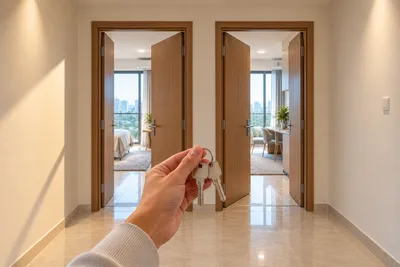
6. Key collection
For HDA projects, the defect liability period (the time the developer answers for defects) is 24 months from the day you get vacant possession, meaning the keys. Walk the unit, list every defect and report it in writing within that time. Defects reported in time are the developer’s to answer for. If they are not sorted out, you can claim at the Tribunal for Homebuyer Claims, for up to RM50,000 per claim. A defect claim must be filed within 12 months after the defect period ends.
The shortcut: WhatsApp us (opens in a new tab) before step 1. Tell us your income and savings, and we can tell you which projects fit your budget. That saves you weekends of wrong showrooms.
This is a general guide, not legal or financial advice. Check your own case with your lawyer and your bank.
Frequently Asked Questions
Can a developer charge a booking fee before I sign the SPA?
Not under the HDA rules. A developer selling under the Housing Development Act may not collect any payment, under any name, except as set out in the sale and purchase agreement (SPA). KPKT (the Ministry of Local Government Development) says in its buyer guide that a booking fee before the SPA is signed is not allowed. You pay a 10% deposit when you sign.
How long does the developer have to hand over the keys?
For a project sold under the Housing Development Act (HDA), 36 months from the SPA date for a condo or apartment, or 24 months for a landed home. If it is late, the developer must pay you LAD (fixed damages for late delivery) of 10% a year on the price, counted day by day.
How long is the defect liability period?
For projects sold under the Housing Development Act (HDA), 24 months from the day you get vacant possession, meaning the keys. Report defects in writing within that time. If they are not sorted out, you can claim at the Tribunal for Homebuyer Claims, for up to RM50,000 per claim, within 12 months after the period ends.
How much can I borrow for my first home?
Each bank sets its own limit on how much of the price it will lend for your first and second home loans. Bank Negara Malaysia also does not publish one number for how much of your income can go to loan repayments, so apply to 2 to 3 banks and compare.
Do first-time buyers pay stamp duty?
A Malaysian first-time buyer of a home up to RM500,000 can be exempt, if the SPA is signed between 1 January 2021 and 31 December 2027. Serviced apartments, SOHOs, SOFOs and SOVOs (small office-style units) are left out, and other conditions apply.
Official sources (8)
- KPKT / Jabatan Perumahan Negara, Panduan Pembeli Rumah (22 April 2021) (opens in a new tab)
- Housing Development (Control and Licensing) Regulations 1989, P.U.(A) 58/1989 (KPKT) (opens in a new tab)
- KPKT, Tribunal for Homebuyer Claims, frequently asked questions (opens in a new tab)
- Housing Development (Control and Licensing) (Amendment) Regulations 2015, Schedules G and H and regulation 8(1A) (opens in a new tab)
- Bank Negara Malaysia, Responsible lending guidelines ensures borrowers affordability (20 Sep 2016) (opens in a new tab)
- Stamp Duty (Exemption) Order 2021, P.U.(A) 53/2021 (opens in a new tab)
- Stamp Duty (Exemption) 2021 (Amendment) Order 2025, P.U.(A) 448/2025 (opens in a new tab)
- Bank Negara Malaysia, Measures in Promoting a Stable and Sustainable Property Market and Sound Financial and Debt Management of Households (3 Nov 2010) (opens in a new tab)
Run your own numbers
Loan Calculator →